
If you are starting an independent travel agency or transitioning from an employee to an independent travel advisor, structuring your business correctly from day one is essential. Selecting the proper legal structure among various travel agency legal entities allows you to protect your personal assets, unlock substantial tax advantages, and establish instant credibility with clients and suppliers.
The primary question for growing agency owners is not whether to incorporate, but which corporate entity best aligns with your financial goals and risk tolerance.
💡 TARC Tip: Treating your agency as a formal corporate entity rather than a casual side-hustle changes how clients, host agencies, and insurance providers treat your business. Formal structure is the foundation of long-term scalability.
Why Professional Advisory Is Non-Negotiable
While online formation platforms make filing paperwork easy, navigating corporate structures requires professional guidance tailored to your personal financial picture.
- Certified Public Accountant (CPA): A qualified CPA evaluates your income, personal assets, and long-term financial targets to recommend an entity structure that minimizes tax liability and prevents double taxation.
- Small Business Attorney: An attorney ensures your formation documents, operating agreements, and state filings comply fully with federal, state, and municipal regulations—while safeguarding your personal assets from business liabilities.
⚠️ Please Note: Choose accounting and legal partners who understand local business regulations and have experience with travel and tourism law, seller-of-travel registration requirements, and independent contractor structures.
Key Business Structures Every Travel Advisor Should Know
Before meeting with your CPA or attorney, familiarize yourself with these fundamental business entity definitions:
- Sole Proprietorship: The simplest structure where one person owns an unincorporated business. It offers no legal separation between personal and business liabilities.
- Doing-Business-As (DBA) / Fictitious Name: An official trade name registered under an individual or existing corporation, allowing you to conduct business under a brand name without forming a new legal entity.
- Limited Liability Company (LLC): A flexible business structure that protects owners from personal liability for business debts and obligations, combining pass-through taxation with corporate protection.
- Limited Liability Partnership (LLP): A partnership structure where individual partners are shielded from the liabilities created by other partners.
- General Partnership: An arrangement where two or more parties agree to share all assets, profits, and financial/legal liabilities of a jointly owned business.
- S-Corporation: A special tax election (for LLCs or corporations) that allows profits and some losses to pass through directly to owners’ personal income, often reducing self-employment taxes.
- C-Corporation: A legal entity distinct from its owners that offers strong liability protection but may be subject to corporate double taxation.
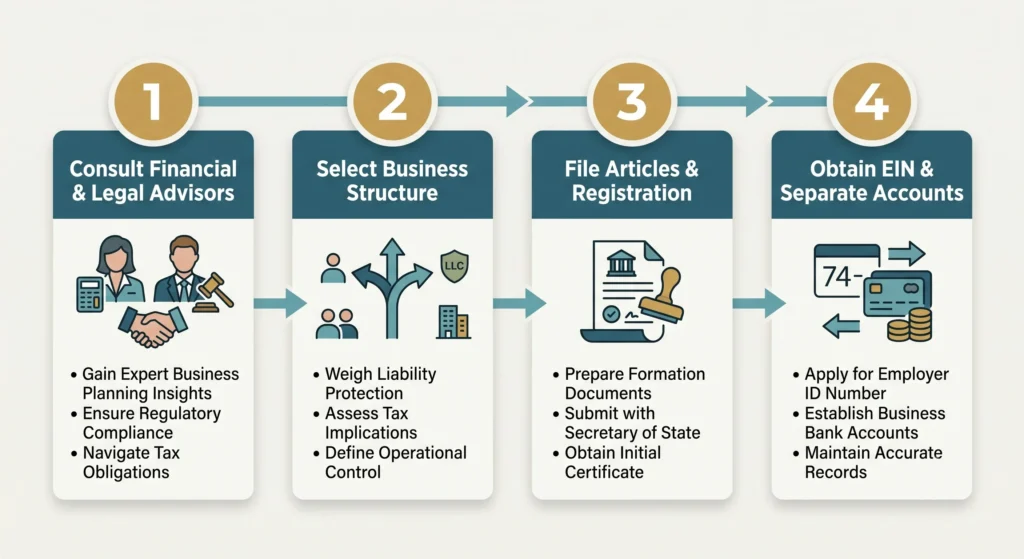
4-Step Roadmap to Structuring Your Travel Agency
Comparing Common Travel Agency Entities
| Structure | Personal Asset Protection | Tax Flexibility | Operational Complexity |
| Sole Proprietorship | None (Personal exposure) | Pass-through to personal tax return | Minimal |
| DBA (Fictitious Name) | None (Attaches to underlying entity) | Depends on base structure | Low |
| LLC | High (Protects personal assets) | Flexible (Pass-through or S-Corp option) | Moderate |
| S-Corporation | High (Protects personal assets) | Potential self-employment tax savings | Moderate to High |
Build Your Agency on a Secure Foundation
Taking time to evaluate travel agency legal entities ensures your business is protected against unexpected risk while maximizing your net income. By combining basic legal literacy with professional guidance from a CPA and travel-savvy attorney, you build an agency designed for long-term equity, stability, and growth.
Ready to Legally Protect Your Travel Business?
Setting up your legal structure is a crucial milestone on your path to building a sustainable, scalable travel agency.
Looking for trusted legal and financial resources? Join the Travel Advisor Resource Center (TARC) community today to access our complimentary Travel Supplier Directory, complete with vetted legal professionals, accounting experts, and agency setup templates built specifically for travel advisors.