
Whether you are just stepping into the travel industry for the first time or you are a seasoned professional looking to optimize your agency’s earnings, understanding the financial mechanics of this career is absolutely essential.
One of the most common questions from prospective entrepreneurs and curious clients alike is exactly how travel advisors get paid. The reality is that the modern travel professional does not rely on just a single paycheck. Today’s top-producing advisors act as true travel CEOs, diversifying their income across multiple distinct revenue streams.
This comprehensive guide will explore the various ways travel advisors earn their income, offering a deep dive into the intricacies of seven different compensation structures you can leverage to build a highly profitable, scalable luxury agency.
1. Commissions From Travel Suppliers
Commissions have historically been the foundation of a travel advisor’s income. These are payouts provided directly by travel suppliers—such as airlines, luxury hotels, cruise lines, and tour operators—as a reward for securing a booking.
When you finalize a reservation for a client, the supplier compensates you with a percentage of the total sale. However, it is crucial to understand that commission payments are rarely immediate. Because clients often book vacations 12 to 18 months in advance, commission income must be viewed as a long-term investment pipeline. Some suppliers release funds shortly after the final payment is processed, while others delay payment until 30 to 60 days after the client has actually traveled.
Here is a breakdown of how supplier commissions typically vary:
- Airline Commissions: Historically, airlines paid robust commissions on every ticket sold. Due to industry cost-cutting, this has significantly decreased. Today, standard domestic flights rarely pay a commission. However, international first-class or business-class tickets can still yield commissions ranging from 5% to 8%, and utilizing airline consolidators can unlock even higher volume-based bonuses.
- Hotel Commissions: Standard hotel commissions typically range from 7% to 15% of the booking value. Luxury hotels and boutique resorts often offer the highest percentages to incentivize advisors to promote their premium properties.
- Cruise Line Commissions: Ocean and river cruise lines generally offer incredibly lucrative commissions, ranging from 10% to 16%—and sometimes soaring as high as 25% for top-tier producing agencies.
- Tour Operator Commissions: Wholesale tour operators bundle accommodations, transfers, and excursions, typically paying out between 10% to 20% on the total package price.
2. Implementing Professional Service Fees
Relying solely on delayed supplier commissions is a risky business model. To supplement their income and protect their time, modern luxury travel advisors charge professional service fees directly to their clients.
These fees ensure that you are fairly compensated for your high-level expertise, dedicated research, and bespoke itinerary design, regardless of whether a client ultimately cancels their trip.
- Consultation and Planning Fees: A non-refundable, upfront fee charged before any research begins. This ensures clients value your expertise and weeds out “tire kickers.” Depending on the complexity of the trip, these typically range from $150 to $500+ per itinerary.
- Ticketing and Booking Fees: Flat rates charged specifically for handling the booking process, most commonly applied to airfare-only requests where supplier commissions do not exist.
- Change and Cancellation Fees: Post-booking modifications are incredibly time-consuming. Charging a clear change fee (ranging from $50 to $200) covers the administrative resources required to overhaul an itinerary on the client’s behalf.
💡 TARC Tip: Never apologize for charging a professional fee! You are a highly skilled consultant, not a free online booking engine. Implementing fees instantly elevates your brand and attracts high-ticket clients who respect your time and expertise.
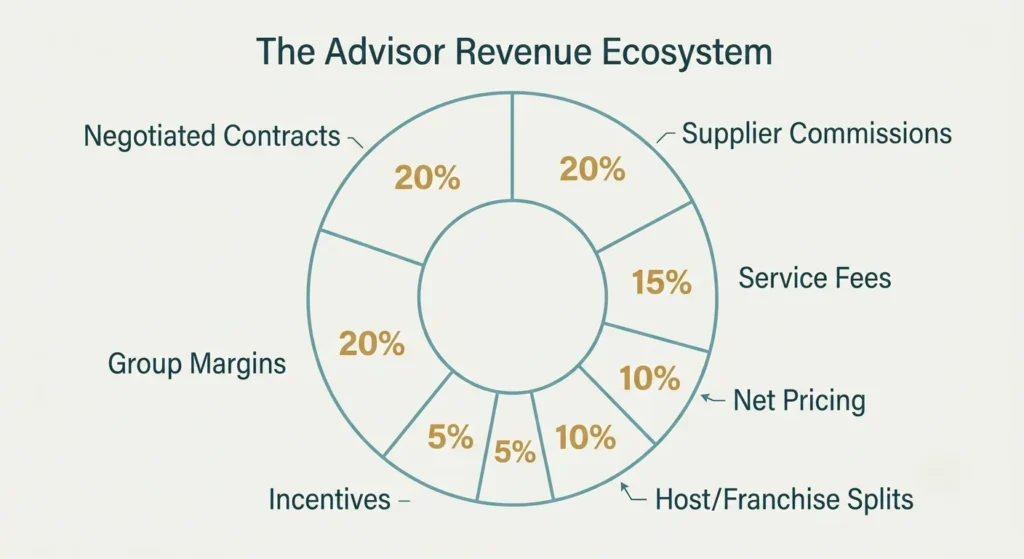
3. Mastering the Net Pricing Model
Net pricing is a highly lucrative model where an advisor purchases travel products at a wholesale (net) rate and sells them to the client at a marked-up retail price, allowing the advisor to directly control their own profit margin.
Under this model, you negotiate directly with suppliers or Destination Management Companies (DMCs) to secure rates significantly lower than public retail prices. You then add a custom markup to cover your time and generate a profit. While this method requires a deep understanding of market pricing, strong negotiation skills, and strict financial accounting, it can drastically increase your overall yield on complex FIT (Free Independent Traveler) itineraries.
4. Leveraging Host Agency and Franchise Support
Many independent travel advisors choose to align their business with a Host Agency or purchase a Franchise. These umbrella organizations provide crucial support, CRM technology, E&O insurance, and instant industry credentials.
The primary difference between the two is operational control: a Host Agency is typically “hands-off,” allowing you to build your own distinct brand, while a Franchise provides a highly structured, “business-in-a-box” model under a recognized corporate name. In return for leveraging their massive buying power, you share your revenue with them.
- Split Commissions: Host agencies typically operate on a commission split model. When a supplier pays out a commission, you split that revenue with your host (commonly ranging from a 70/30 to a 90/10 split in the advisor’s favor, based on your sales volume).
- Tiered Growth: As your sales volume grows year over year, most host agencies will automatically bump you into a higher commission bracket, allowing you to keep more of your hard-earned money.
5. Capitalizing on Incentives, Bonuses, and Rewards
Beyond standard commissions, elite travel advisors can earn substantial incentives and bonuses tied directly to performance metrics.
Travel suppliers design these programs to motivate advisors to actively promote their specific brand. These can take the form of cash bonuses, free room nights, complimentary FAM (Familiarization) trips, or luxury merchandise. For example, a luxury river cruise line might offer a $250 cash bonus for every fifth cabin booked during a promotional period, or a resort brand might award you a complimentary five-night stay after you sell ten rooms. These perks dramatically enhance your overall compensation package.

6. Scaling With Group Bookings and Events
If you want to scale your income rapidly, you must master the art of the group booking. Organizing corporate retreats, multi-generational family reunions, or lavish destination weddings is one of the most profitable business models in the industry.
Instead of spending ten hours planning a trip for two people, you spend those same ten hours designing an itinerary that is then duplicated for fifty people. This allows you to stack supplier commissions, charge larger overarching management fees, and often earn “Tour Conductor” (TC) credits, which can translate into free travel for you or additional pure profit for your agency.
7. Securing Negotiated Supplier Contracts
As you establish your agency and begin generating a massive volume of sales, you unlock the ability to negotiate directly with suppliers.
Experienced travel CEOs leverage their impressive sales data to secure elevated, customized commission rates or exclusive client amenities (like complimentary spa credits or room upgrades) that are completely unavailable to the general public. Building deep, mutually beneficial relationships with Business Development Managers (BDMs) is the ultimate key to negotiating these elite contracts and maximizing your profitability.
⚠️ Please Note: Transitioning from a hobbyist to a highly profitable agency owner requires impeccable financial tracking. You must keep your personal and business finances strictly separated, and we highly recommend consulting with a travel-specific CPA to manage your diverse revenue streams properly.
Diversify Your Revenue Streams
The modern travel advisor does not survive on just one source of income. By understanding how travel advisors get paid and strategically combining supplier commissions, upfront service fees, and high-margin group bookings, you can build a sustainable, wildly profitable career. Stop leaving money on the table, define your pricing structure today, and watch your travel empire grow.