
Travel agents have been a cornerstone of the hospitality industry for as long as most of us can remember. The profession began decades ago, long before the convenience of the internet, back when agents had to handwrite airline tickets, call heavily congested reservation offices to book clients, and remain tethered to their desks, landlines, and fax machines.
The industry has come an incredibly long way since those days, and so has the profession itself.
Unfortunately, a lingering public misconception remains that travel agents are merely hobbyists looking for discounted trips, or retirees looking for something to do to pass the time. In the past, the career was often associated either exclusively with the ultra-wealthy who had money to burn, or with travelers who were simply too lazy to book their own flights.
Thankfully, the landscape has completely shifted. Due to the tireless advocacy of professional organizations like the American Society of Travel Advisors (ASTA), the public perception is evolving. The modern conversation isn’t just about booking a trip; it is about the fundamental difference between a travel agent vs travel advisor.
From Transactional Order Takers to Trusted Advisors
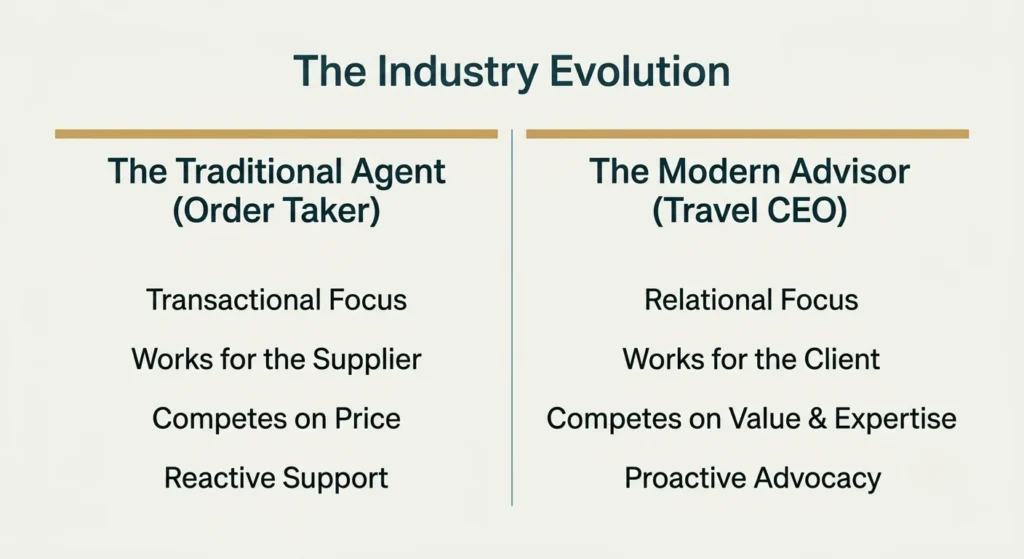
Many consumers do not immediately understand the true value of a luxury travel advisor. They often assume the process is entirely transactional: they call in, tell the agent what they want, the agent clicks a few buttons, and they are booked. If it is that simple, why would anyone use a third-party representative instead of just calling the hotel or cruise line directly?
This is where the distinction between an order-taker and a professional travel advisor becomes crystal clear.
Travel advisors work exclusively for their clients, not for the suppliers. While a top-tier advisor builds incredible, lucrative relationships with their supplier representatives, their unwavering loyalty lies with the traveler. They act as a dedicated expert, sifting through a sea of overwhelming options, leveraging their personal experiences in destinations, and advocating fiercely for their clients at every stage of the journey.
When a consumer calls a massive supplier call center, they are speaking to a representative whose primary goal is to close the transaction quickly and move on to the next caller in the queue. That representative is also strictly limited to selling their own brand’s products. Conversely, a professional travel advisor has access to a global portfolio of suppliers. They will emphatically educate a client on exactly why a specific boutique hotel or luxury cruise line is a better fit for their unique anniversary trip than the one they saw in a generic online ad.
⚠️ Please Note: In 2019, ASTA officially changed its name from the American Society of Travel Agents to the American Society of Travel Advisors. As ASTA President Zane Kerby stated, this change “more accurately describes the value our members provide to consumers and is a distinct declaration of whom we work for: the traveling public.”
The Catalyst: How Travel Advisors Emerged on Top
Between 2020 and 2022, the global travel industry faced its most severe crisis in modern history. As borders closed and restrictions tightened, the sheer chaos changed the landscape of travel forever.
According to the Bureau of Transportation Statistics, Americans took 2.8 billion fewer trips on the 4th of July in 2020 compared to the previous year. The global tourism industry suffered a devastating blow, with total export revenues plummeting from $1.2 trillion to just over $910 billion due to decreased demand (Tourism And Covid-19 – Unprecedented Economic Impacts).
During this era of mass cancellations, the industry lost many agents who realized the stress was simply no longer worth it. However, as travel rebounded exponentially in 2021 and 2022, something incredible happened.
Travelers who had booked directly with airlines and online booking engines found themselves stranded on hold for hours, losing thousands of dollars in hidden cancellation fees, and receiving zero guidance. Meanwhile, travelers who had utilized a travel advisor experienced something entirely different. Their advisors navigated the complex new protocols, fought for their refunds, rebooked their itineraries seamlessly, and most importantly, gave them back their precious time and peace of mind. Frustrations with DIY travel grew, and the undeniable value of the travel professional skyrocketed.
What is the Real Difference Between an Agent and an Advisor?
Technically speaking, the logistical roles are the same: both facilitate the booking of flights, hotels, and tours. However, the approach is what separates a travel agent vs travel advisor.
Personal attention and holistic care are the centerpieces of an advisor’s business model. For an advisor, service does not end just because the credit card was charged or the trip is over. Much like a CPA, a financial planner, or an attorney, travel advisors provide maximum value by helping consumers make complex, high-stakes decisions about their hard-earned investments.
Today’s advisors do more than just book; they curate. They get to know their clients intimately—understanding their specific preferences, their traveling companions, and their deep-seated travel dreams. They typically specialize in a highly specific niche, transforming themselves into true authorities on luxury safaris, destination weddings, or European river cruises.
💡 TARC Tip: Because modern advisors act as expert consultants who curate bespoke experiences and offer concierge-level support, they are increasingly moving away from relying solely on commission. Transitioning to a fee-based model (charging professional planning or retainer fees) is the ultimate declaration that you are a highly skilled advisor, not a free booking engine.
Step Into Your Role as a Professional Advisor
Whether you still affectionately call yourself a travel agent or you have fully embraced the title of travel advisor, the reality is that your role in this industry is more vital now than ever before.
Modern travelers are overwhelmed by endless online options, conflicting reviews, and complex supplier terms. They do not need another booking engine; they need a trusted advocate. Step confidently into your expertise, focus on providing unparalleled value, and watch your business transform from a transactional agency into a highly sought-after luxury advisory firm.